RPA or AI Agent.
How two technologies that could be viewed as rivals might be complements. Reviewing the "how" Vs. the "why"

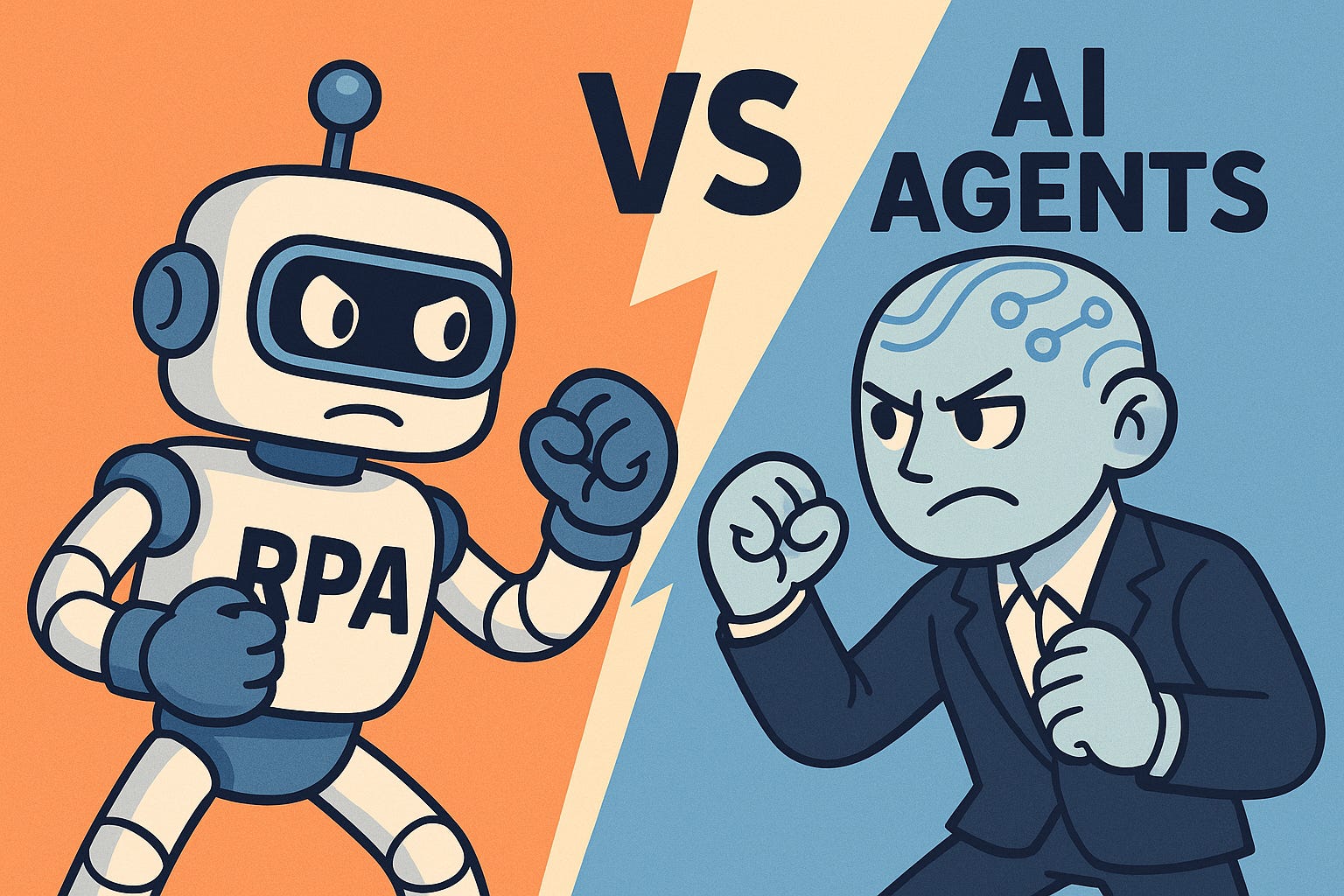
When RPA Is Enough (and When You Actually Need an AI Agent)
By Rodrigo Londoño
A few months ago, I attended a major tech fair. Walking through the exhibition hall, I noticed something striking: about 80% of the solution booths were promoting AI Agents. Everyone claimed to have the fastest, smartest, most reliable automation technology.
But as I listened to pitch after pitch, one thought kept coming back to me: not everything needs to be “intelligent.” In the rush to brand every process as “AI-powered,” many seem to have forgotten the foundation of automation itself — RPA (Robotic Process Automation).
RPA may not sound as shiny or futuristic as an “agent,” but it remains one of the most effective, affordable, and reliable tools for businesses that simply need to automate repetitive tasks.
So, before you replace your bots with “agents,” let’s take a clear look at what both technologies actually do — and when each one makes sense.
What RPA Really Is
RPA stands for Robotic Process Automation, and it’s exactly what it sounds like: a software robot that mimics human actions within a digital system.
Think of RPA as the ultimate intern — fast, obedient, and consistent. You teach it a sequence (copy this data from Excel, paste it into a CRM, send an email confirmation), and it will follow that sequence perfectly, 24/7.
RPA excels at structured, rule-based, repetitive tasks. It doesn’t think, but it doesn’t need to. That’s what makes it affordable and dependable.
Example:
A hospital uses an RPA bot to process hundreds of insurance claims. Each claim follows the same pattern — extract patient data, upload it to a portal, send a confirmation email. There’s no need for reasoning or decision-making — just speed and accuracy.
Why companies love RPA:
Quick to deploy and low cost.
Works with legacy systems without APIs.
Delivers high accuracy in repetitive tasks.
Scales easily across departments.
Limitations:
Can’t adapt to changes or exceptions.
Doesn’t “learn” or “understand” context.
Breaks if the interface changes or the process isn’t consistent.
What AI Agents Really Are
Now, let’s talk about the newcomers: AI Agents — the autonomous cousins of RPA bots.
An AI Agent doesn’t just follow instructions — it can understand goals, reason through options, and take action based on context. It’s powered by artificial intelligence models (like GPT-5 or other LLMs), combined with APIs and workflow orchestration.
If RPA is a rule-follower, an AI Agent is a problem-solver.
Example:
Instead of just copying data, an AI Agent could read a doctor’s email, understand the urgency, check the patient record, verify insurance status, and prioritize the case — all without being explicitly told every step.
Why businesses are adopting AI Agents:
They can make decisions, not just execute steps.
Handle unstructured data like emails, PDFs, and conversations.
Interact with multiple systems dynamically.
Continuously improve through learning loops or fine-tuning.
Limitations:
More expensive to build and run (compute + API costs).
Require more monitoring to ensure reliability.
May “hallucinate” or misinterpret instructions if not trained correctly.
RPA vs AI Agents — A Practical Comparison
Criteria
RPA (Robotic Process Automation)
Nature
Rule-based automation
Type of Tasks
Repetitive, structured, predictable
Data Input
Structured (forms, tables, systems)
Learning Ability
None
Cost
Low setup and operation
Speed of Implementation
Fast — weeks
Maintenance
Needs manual updates
Best Use Case
Invoice processing, data migration, report generation
Criteria
AI Agents (Autonomous Agents)
Nature
Context-aware, goal-driven intelligence
Type of Tasks
Variable, analytical, decision-based
Data Input
Unstructured (emails, text, documents)
Learning Ability
Can learn or adapt (via AI models)
Cost
Higher (API, compute, training)
Speed of Implementation
Slower — requires integration & testing
Maintenance
Can self-adjust to changes
Best Use Case
Customer support, triage, analysis, dynamic workflows
How to Choose Between RPA and AI Agents
Here’s the real question: Do you need intelligence, or just automation?
If your process is predictable — like entering data, reconciling payments, or moving files — RPA is perfect. It’s simple, fast, and cost-effective.
If your process requires judgment, reasoning, or adaptation, like analyzing customer sentiment or responding dynamically to changing data, AI Agents are the better choice.
Example: A Healthcare Use Case
Imagine a medical billing process.
With RPA, you can automatically extract data from patient charts, verify insurance codes, and generate invoices.
With AI Agents, you can go further — identify billing errors, flag anomalies, predict denials, and even draft appeals automatically.
However, cost matters. In many regions, including Colombia, the price of running AI Agents is still comparable to hiring human staff, while RPA can deliver automation for a fraction of the cost.
That’s why the smartest organizations today aren’t choosing one over the other — they’re combining both.
The Future: A Hybrid Model
The truth is, AI Agents won’t replace RPA — they’ll extend it.
RPA will continue to serve as the backbone of automation: executing repetitive, rule-based processes efficiently.
AI Agents will sit on top of that foundation, adding intelligence, analysis, and autonomy when needed.
Picture it like this:
RPA handles the “how.”
AI Agents handle the “why.”
In the coming years, the most efficient businesses will use RPA for precision and AI Agents for perception. Together, they’ll build automation ecosystems that are both fast and smart.
Conclusion
Automation isn’t a beauty contest between RPA and AI Agents. It’s a collaboration.
RPA is not outdated — it’s essential. It frees humans (and even AI Agents) from mundane work. AI Agents, meanwhile, expand what’s possible — understanding, reasoning, and adapting in ways RPA never could.
So next time someone asks, “Which is better — RPA or AI Agents?”
The best answer is simple:
It depends on what you need.
If your process needs speed and structure, choose RPA.
If it needs autonomy and intelligence, go for AI Agents.
And if you want the future — combine both.
“Rodrigo Londoño is the CEO of TeleMed, a healthcare BPO and automation company transforming medical operations through AI and process optimization.”